69 Fish Species of the Black Sea Identified Along the Romanian Coast – INCDM Atlas 2022
Romania's marine biodiversity, especially along the Black Sea coast, has become an increasingly important topic in the context of climate change, intensive fishing, and anthropogenic impacts on ecosystems. In this regard, the most recent research conducted by the National Institute for Marine Research and Development "Grigore Antipa" Constanța (INCDM) provides an updated and comprehensive picture of the fish species in the Black Sea that can be found in Romania’s territorial waters.
The scientific publication entitled “Fish Species of the Romanian Coast – Updated Atlas”, published in 2022, is the result of a monitoring effort carried out over a period of 10 years (2012–2022). The study is signed by a team of specialists in marine biodiversity and ichthyofauna: M. Nicolaev, G. Radu, L. Radu, A. Micu, C. Nicolaev, G. Anton, M. Manea, M. Niță, I. Nicolaev.
In total, 69 fish species were identified, and the results are publicly available in electronic format on the ResearchGate platform: 🔗 Updated Atlas – ResearchGate (2022)
This article aims to synthesize the most relevant data from the atlas, focusing on species status, commercially valuable fish, and key conclusions for the future of the Romanian marine ecosystem.
What Threatens Romania's Fish Ecosystem?
Romania's marine ecosystem, especially the coastal zone of the Black Sea, is increasingly vulnerable to various pressures that significantly influence the structure, diversity, and distribution of fish species. The study conducted by INCDM Constanța highlighted that current imbalances result from a combination of both natural and anthropogenic factors.
Among the most significant impact factors are:
- Overfishing – Intensive exploitation of certain species, especially those with economic value, has led to a decline in populations and disrupted the marine food chain.
- Improper use of fishing gear – Small mesh nets or illegal fishing during breeding bans affect natural reproduction and remove young specimens before reaching maturity.
- Water pollution – Discharge of wastewater, agricultural fertilizers, and microplastics deteriorate marine habitat quality and may alter species' behavior and physiology.
- Coastal urbanization and mass tourism – Human activity in coastal areas reduces natural breeding and feeding grounds, particularly in lagoon or estuarine zones.
- Climate change – Rising water temperatures and changing salinity levels encourage the spread of invasive species and push native species into less favorable areas.
- Introduction of invasive species – Some species have been accidentally introduced via maritime transport or migration and have affected native competition, consuming the same resources or becoming direct predators.
All these factors act cumulatively and contribute to changes in the composition of ichthyofauna in the Black Sea. Thus, even though the total number of fish species may appear relatively stable, their distribution and abundance have changed significantly over the past decade. Many species that were common in previous years now appear only sporadically, while others, once rare or invasive, are becoming dominant in certain habitats.
In this context, Romania's marine biodiversity is at a crossroads, and scientific studies like the one conducted by INCDM are essential for understanding and sustainably managing aquatic resources.
Research Results: 69 Species in 10 Years
The study conducted by the INCDM Constanța team during the period 2012–2022 led to an updated database on the fish species in the Black Sea observed along the Romanian coastline. A total of 69 fish species were identified, grouped by frequency of occurrence and ecological status.
Here are some key findings of the study:
- The total number of species has slightly increased compared to previous decades, likely due to intensified monitoring efforts and expanded observation areas.
- The number of constantly present species has decreased, indicating reduced ecological stability. Many previously common species are now rarely encountered.
- The number of species considered rare has increased, appearing sporadically or accidentally in coastal areas. This may signal changes in temperature, salinity, or interspecific competition.
- Some invasive species have become more frequent, affecting the natural balance between native species.
In the atlas, the fish were also analyzed based on habitat type: marine (saltwater), brackish, and freshwater. This classification highlights the biological diversity and adaptability of species to the specific conditions of the Romanian coast.
It is also noteworthy that Romania's coastal area presents a complex interaction between migratory, sedentary, and invasive species, making the Black Sea a dynamic, yet increasingly fragile ecosystem.
Research Results: 69 Species in 10 Years
The study conducted by the INCDM Constanța team between 2012 and 2022 led to the updating of the database on fish species in the Black Sea observed along the Romanian coastline. In total, 69 fish species were identified, grouped according to their frequency of occurrence and ecological status.
Here are some key findings of the research:
- The total number of species has slightly increased compared to previous decades, which may be attributed to intensified monitoring efforts and the expansion of observation areas.
- The number of constantly present species has decreased, indicating a reduction in ecological stability. Many species that were once common are now encountered less frequently.
- The number of species considered rare has increased, appearing isolated or accidentally in coastal zones. This may signal changes in temperature, salinity, or interspecific competition.
- Some invasive species have become more frequent, impacting the natural balance between native species.
In the atlas, the fish were also analyzed based on their type of habitat: marine (saltwater), brackish, and freshwater. This classification highlights the biological diversity and adaptability of species to the specific conditions of the Romanian coastline.
It is also worth noting that along Romania’s coastal area there exists a complex interaction between migratory, sedentary, and invasive species, which makes the Black Sea a dynamic yet increasingly fragile ecosystem.
The 20 Commercially Important Fish Species
As part of the research conducted by INCDM Constanța, 20 fish species with economic value were identified—species that are frequently fished for human consumption and regularly found in markets and restaurant menus along the Romanian coast.
The list of these commercial species includes:
- Sprat (Sprattus sprattus)
- Anchovy (Engraulis encrasicolus)
- Horse mackerel (Trachurus mediterraneus)
- Black Sea shad (Alosa tanaica)
- Bluefish (Pomatomus saltatrix)
- Mullet (Chelon auratus, Chelon saliens, Chelon ramada)
- Laban
- Red mullet (Mullus barbatus)
- Big-scale sand smelt (Atherina boyeri)
- Danube shad (Alosa immaculata)
- Black goby (Gobius niger)
- Strunghil
- Round goby (Neogobius melanostomus)
- Turbot (Scophthalmus maeoticus)
- Dogfish / spiny dogfish (Squalus acanthias)
- Flounder
- Sole
- Black Sea sprat (Clupeonella cultriventris)
- Whiting (Merlangius merlangus)
- Garfish (Belone belone)
These species cover a wide range of habitats and ecological behaviors—from pelagic migratory fish like shads and bluefish to benthic sedentary species such as flounder or turbot. Most are caught using either traditional or industrial fishing tools and are sold fresh, frozen, or processed.
In terms of human consumption, many of these species have a high gastronomic value. For example, turbot is considered a delicacy in seaside restaurants, while mullet, anchovy, and Danube shad are extremely popular in traditional local dishes.
It is important to note that some of these species are also included in the vulnerable or ecologically threatened categories according to the IUCN classification. Therefore, stock monitoring and the adoption of sustainable fishing practices are essential to ensure the continuity of these valuable resources.
IUCN Status of the Identified Species
As part of the study conducted by INCDM Constanța, each of the 69 fish species in the Black Sea was analyzed and classified according to IUCN criteria (International Union for Conservation of Nature). These criteria help assess the extinction risk of each species and are essential for setting priorities in biodiversity conservation.
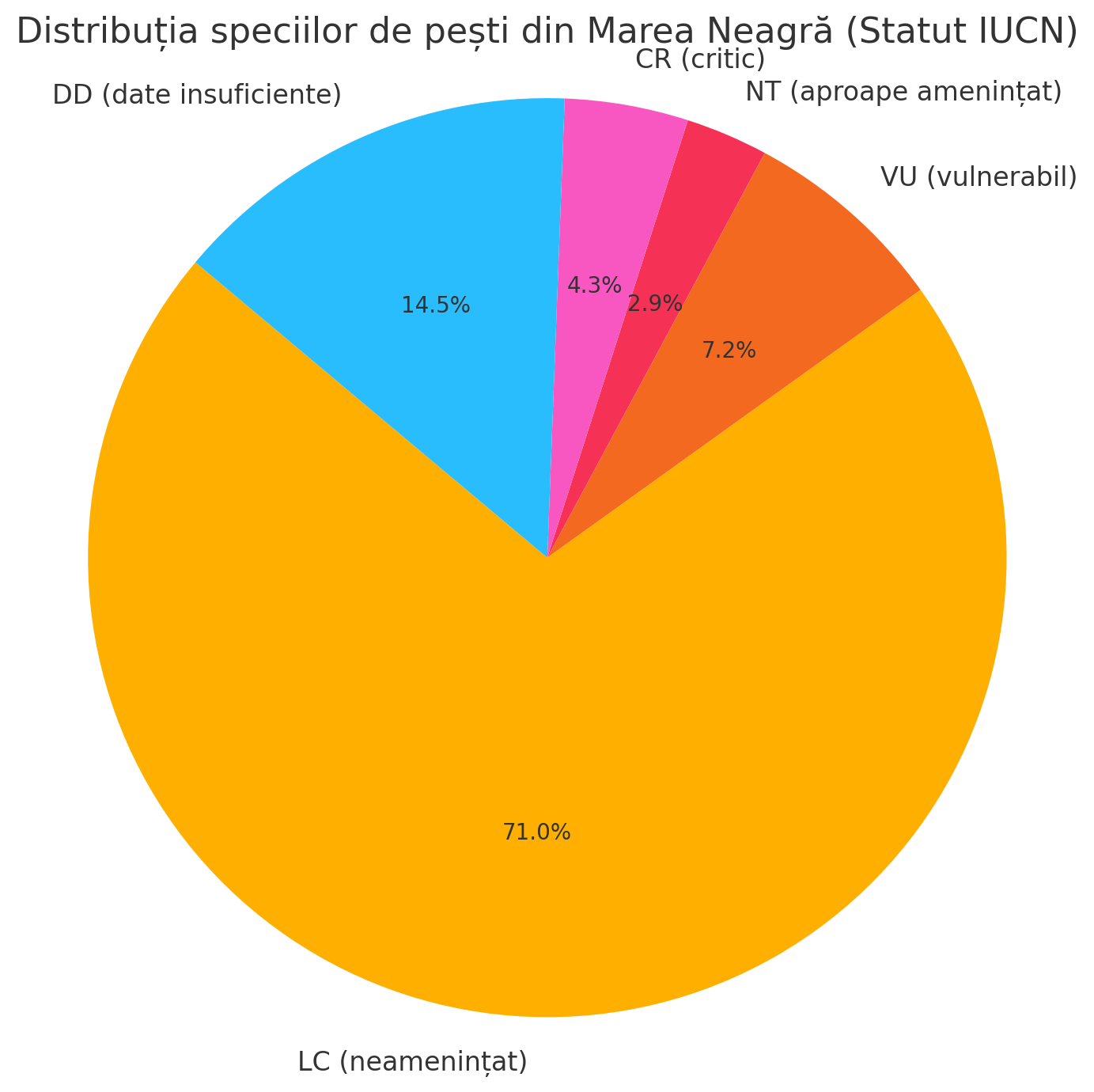
Of all the species analyzed, the distribution across IUCN categories is as follows:
- LC (Least Concern): 49 species
- VU (Vulnerable): 5 species
- NT (Near Threatened): 2 species
- CR (Critically Endangered): 3 species
- DD (Data Deficient): 10 species
The 3 critically endangered species (CR) are sturgeons: beluga, Russian sturgeon, and stellate sturgeon – migratory species of high ecological and economic value. These species are subject to strict protection measures, and their commercial fishing is prohibited.
In the vulnerable (VU) category are species such as Danube shad, bluefish, pout (miller's thumb), and the spiny dogfish – all under pressure from overfishing and habitat degradation.
Other species, such as the seahorse and the stingray, are classified as DD – Data Deficient, meaning there is not enough scientific information to accurately determine their risk category.
Visual representation of the distribution of these species by IUCN category: See the Image - Distribution of Black Sea Fish Species (IUCN)
This data shows that while the majority of species along the Romanian coast are not in immediate danger of extinction, a significant percentage requires constant monitoring and well-structured conservation interventions.
The Silent Invasion: Invasive vs. Native Species
One of the most significant phenomena affecting Romania’s marine biodiversity is the increasingly frequent appearance of invasive fish species. These enter the Black Sea ecosystem through natural migration, maritime transport (e.g., ballast water), or as a result of climate change, which creates favorable conditions for their reproduction.
Although some of these species may seem harmless at first, they can severely impact native species through:
- direct competition for food and breeding grounds,
- spreading diseases and parasites previously unknown to local fauna,
- disrupting the trophic balance in affected areas,
- interfering with the natural life cycles of native fish.
Following the study conducted by INCDM, several invasive fish species have been identified along the Romanian coastline, including:
- Round goby (Neogobius melanostomus) – introduced from the Caspian Sea region, it spread rapidly and directly competes with native gobies.
- Black Sea sprat (Clupeonella cultriventris) – a pelagic invasive species that affects zooplankton and the larvae of other fish species.
- Garfish (Belone belone) – although native in parts of Europe, its population has abnormally expanded in the northwestern Black Sea region.
On the other hand, there are native and endemic species that are in decline due to ecological pressures, such as mullet, turbot, goby, and flounder. These species are becoming increasingly rare in areas where they were once dominant.
The massive presence of invasive species endangers the stability of Romania’s marine ecosystem. To prevent a complete imbalance, control measures, continuous monitoring, and raising public awareness about this silent but dangerous phenomenon are essential.
What Fish Are We Putting on the Table? A Guide to Responsible Consumption
Many Black Sea fish species end up directly on the tables of Romanians, especially in coastal areas where fishing traditions are still alive. However, choosing fish for consumption should not be based solely on taste, but also on environmental responsibility and species conservation.
Here are some of the most frequently consumed commercial species and sustainability considerations:
- Mullet – highly appreciated in grilled dishes; its population is slightly declining in some areas, but it is not currently threatened.
- Anchovy – strong flavor, caught seasonally; its natural abundance makes it a sustainable choice.
- Turbot – considered a delicacy, but its catches are decreasing; requires stricter regulations.
- Danube shad – migratory and classified as vulnerable by the IUCN; responsible consumption is recommended, especially outside the breeding season.
- Horse mackerel – accessible and tasty, populations are stable.
- Goby and flounder – easily found in local markets, typically caught using traditional fishing tools.
Choosing these fish based on season, local sourcing, and capture methods can help protect the marine ecosystem. Avoiding endangered species or those obtained through illegal fishing is also essential.
At Terasa cu Ancore, we are guided by principles of responsible fishing and careful selection of raw materials. We collaborate with local fishermen and serve only fish sourced from verified, sustainable sources — with full respect for the Black Sea.
We encourage our customers to be part of this sustainable chain — by choosing fresh, seasonal fish and becoming informed about the impact their choices can have on the fish fauna of Romania.
Conclusions & Message from the Experts
The study conducted by INCDM Constanța provides a clear, updated, and extremely valuable overview of the current state of fish biodiversity along the Romanian coast. With 69 fish species identified in the past decade and numerous warning signs regarding ecological stability, the researchers’ conclusions are clear: concrete, sustained, and well-coordinated action is needed.
The experts highlight the following key points:
- Continue annual monitoring of fish species diversity to detect ecological imbalances in time.
- Implement and enforce conservation measures, especially regarding vulnerable and critically endangered species.
- Control invasive species and prevent their spread in sensitive coastal areas.
- Promote collaboration between researchers, fishermen, and local authorities to protect marine habitats.
- Raise awareness and educate the general public about the importance of sustainable food choices and their impact on the marine ecosystem.
At the same time, each of us has a role to play. From the fish we choose to put on our plates to supporting local initiatives aimed at protecting the marine environment, responsible consumption and accurate information can truly make a difference.
The Black Sea is a living, fragile, and fascinating ecosystem. By protecting it, we not only safeguard fish biodiversity, but also the traditions, resources, and identity of our coastal communities.
Source and Official Bibliography
The information presented in this article is extracted from a reference scientific study conducted by researchers from the National Institute for Marine Research and Development "Grigore Antipa" in Constanța. The document provides a detailed and well-documented overview of the fish species found in the Black Sea within Romania’s territorial waters over the last decade.
Full reference:
Nicolaev M., Radu G., Radu L., Micu A., Nicolaev C., Anton G., Manea M., Niță M., Nicolaev I. (2022).
Fish Species of the Romanian Coast – Updated Atlas / Speciile de pești de la litoralul românesc – Atlas actualizat.
National Institute for Marine Research and Development "Grigore Antipa", Constanța.
We thank the INCDM team for their efforts in documenting the current state of marine biodiversity in Romania — a valuable resource for both researchers and the general public.